Commercial Small Stock Farming Course
$302.39
Learn commercial small stock farming over 24 weeks — grazing, browsing and zero-grazing systems, breeding, health, nutrition and marketing. Enrol now.
Description
Why take a commercial small stock farming course?
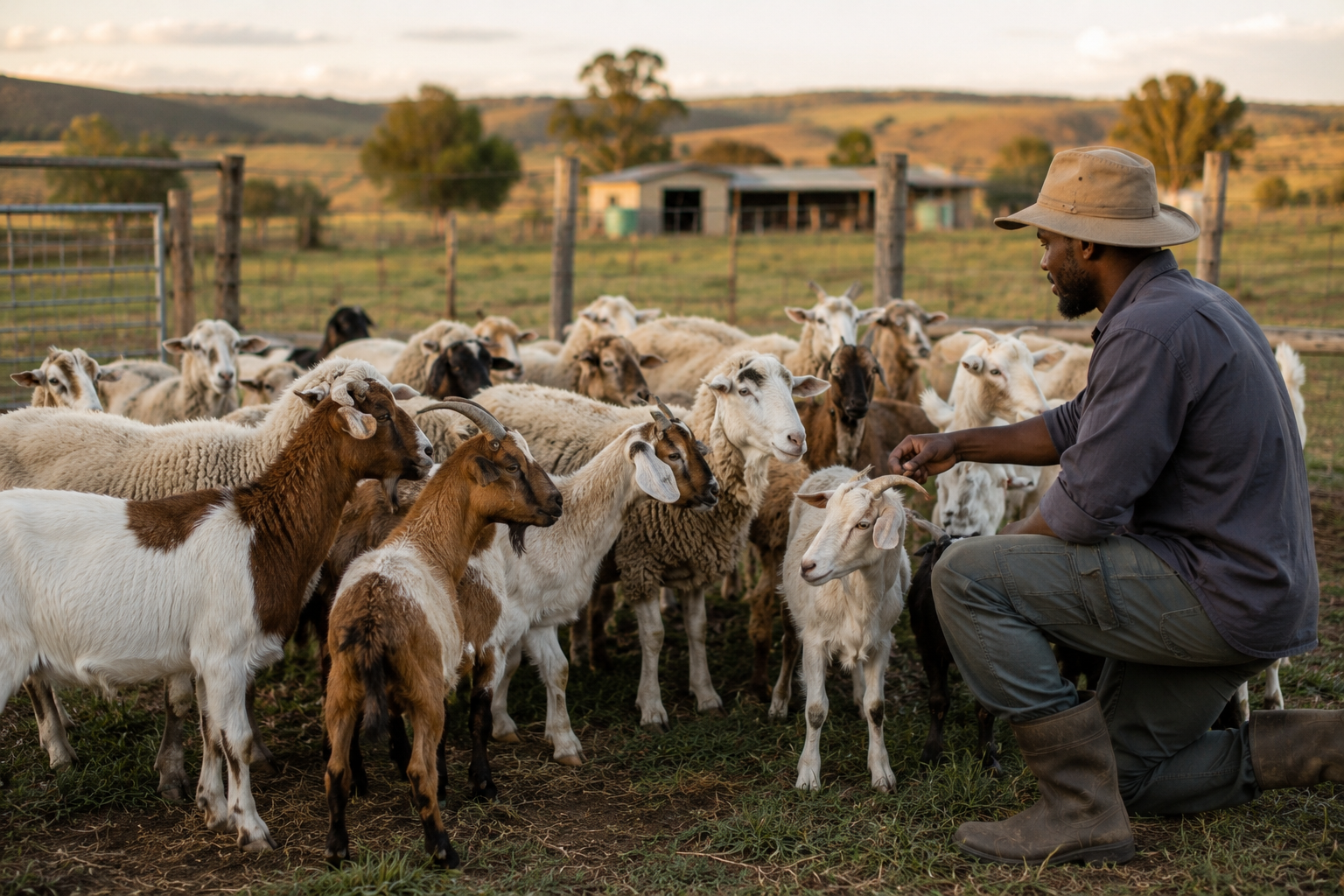
Running small stock commercially means choosing the right production system for your land, your market, and your management capacity — and that’s exactly what this commercial small stock farming course is built to teach. Because feeding and breeding decisions are so closely linked, the course covers both grazing/browsing and zero-grazing systems in full, so that you can farm with a clear strategy rather than by default.
Two small stock production systems, covered in full
- Grazing and browsing systems — working with the veld, seasonal feed availability, and lower input costs
- Zero-grazing (intensive feeding) systems — controlled feeding for faster, more predictable production
Why intensive small stock feeding demands intensive breeding
However, feeding small stock intensively costs money — and the course makes clear that this only makes economic sense if your breeding programme keeps pace. You’ll learn why moving to zero-grazing means you also need to intensify your breeding management, so your reproductive output justifies the higher feed input costs. Get this balance wrong, and intensive feeding becomes a cost you can’t recover.
24-week course outline
Topic 1 — Reproduction and Breeding (Weeks 1–7)
Week 1 — Reproduction:
Info about class organization · Male & Female Reproductive System
Week 2 — Reproduction:
The effect of hormones on reproduction · Manipulating them for oestrus synchronization, AI, and egg transplantation
Week 3 — Reproduction:
Heat spotting and management aids · Pregnancy scanning
Week 4 — Breeding:
Common breeds used in commercial production · Cross-breeding and hybrid vigour
Week 5 — Breeding:
Extensive farming with the seasons · Intensive breeding for intensive feeding situations
Week 6 — Breeding:
Selection and culling of breeding stock · Physical evaluation
Week 7 — Breeding:
Genotype vs phenotype · Heritability of the most important production traits
Topic 2 — Welfare, Health, Handling & Diseases (Weeks 8–15)
Week 8:
The 5 duties of care in animal welfare · Temperature management strategies · Stocking rates in grazing/browsing situations · Using stocking rates to control invasive species/weeds
Week 9:
Space requirements in feedlots/zero-grazing situations · Trough space · Design principles of intensive stocking facilities
Week 10 — Health & Diseases:
Internal parasite control · Resistance to oral drenches · Biological control methods · Signs & symptoms, prevention & control · New technologies
Week 11 — Health & Diseases:
External parasite control · “Blocking” and natural immunity building · Signs, symptoms, post-mortem, and what to look for
Week 12 — Health & Diseases:
Vaccinations & immunity theory · Zoonotic diseases affecting reproduction · Notifiable diseases · Common routinely vaccinated-for diseases
Week 13 — Health & Diseases:
Metabolic disorders · Poison plants
Week 14 — Handling & Stockmanship:
Routine husbandry procedures
Week 15 — Handling & Stockmanship:
Herd dynamics · Low-stress handling and moving of livestock
Topic 3 — Nutrition, Digestion, Feeds & Feeding (Weeks 16–21)
Week 16 — Digestion (The Ruminant Digestive System):
Why do ruminants have 4 stomachs? · Organs and functions
Week 17 — Nutrition & Digestion:
What nutrients does the body need? · What does each nutrient do in the body? · Where and how is each nutrient digested?
Week 18 — Nutrition & Digestion:
Energy digestion · Energy requirements of different classes of small stock
Week 19 — Nutrition & Digestion:
Protein digestion · Protein requirements of different classes of small stock · Supplementing protein (when, how, and pitfalls)
Week 20 — Feeds and Their Nutritional Value:
Nutritional values of some grasses and trees/bushes · Feed ingredients for supplementation or zero-grazing systems
Week 21 — Feeding Systems:
Basic ration balancing
Topic 4 — Managing the Breeding Flock & Marketing Offspring (Weeks 22–24)
Week 22 — Mating and Early/Mid Gestation:
Deciding when to lamb/kid · Natural mating season length variance between breeds · Preparation of rams/bucks for mating season · Fertility & STD check-ups · Use of “teasers” · Use of harnesses with crayon markers
Enroll today
Learn to run a commercial small stock operation that matches production system to economics — enroll in the course today.
Reviews
There are no reviews yet.